If you’ve been researching skin tightening, wrinkle reduction, laser resurfacing, or non-surgical facial rejuvenation, you’ve probably noticed that there are many different technologies available. Microneedling, CO₂ lasers, RF treatments, and other aesthetic lasers can all improve the appearance of the skin—but they don’t all work in the same way.
At Balanced Body Weight Loss & Wellness in St. Louis, we offer Fotona laser treatments using advanced dual-wavelength laser technology designed to address multiple layers and concerns of the skin. One of the biggest advantages of Fotona is its versatility: treatment settings can be adjusted to target different depths and goals, allowing your treatment to be customized to the results you’re looking for and the amount of downtime you’re comfortable with.
So, what makes Fotona different?
What Is the Fotona Laser?
Fotona is an advanced laser platform that can use two complementary wavelengths: Er:YAG and Nd:YAG. Each wavelength interacts with tissue differently, allowing the technology to address both superficial and deeper areas.
The Er:YAG wavelength is highly absorbed by water and can be used for precise superficial skin treatments and resurfacing. Depending on the settings, Er:YAG can also be used in non-ablative modes that heat the skin without removing the surface.
The Nd:YAG wavelength penetrates more deeply and can create controlled thermal effects in the deeper layers of the skin. Fotona’s technology can therefore be used to stimulate collagen remodeling and address concerns at different depths. (Fotona)
This combination is one of the reasons Fotona stands out from many single-wavelength aesthetic laser systems. Instead of having only one type of laser energy available, Fotona’s dual-wavelength platform gives trained providers multiple ways to customize treatment.
Why Is Fotona Different From Other Aesthetic Lasers?
Not every laser treatment is designed to do the same thing. Some laser systems primarily target the surface of the skin, while others are designed to heat deeper tissue. Some treatments intentionally remove layers of skin, while non-ablative treatments work beneath the surface without removing it.
Fotona’s flexibility allows treatment parameters to be adjusted depending on the patient’s goals.
For example, Fotona technology can be used for treatments designed to improve the appearance of:
- Fine lines and wrinkles
- Skin laxity
- Uneven skin texture
- Acne scars and other scars
- Skin tone and overall appearance
- The lips
- The area around the eyes
- The neck and jawline
Fotona’s 4D approach combines complementary laser modes to address tissue at different depths. The technology can stimulate collagen remodeling while also addressing the skin’s surface and deeper layers. (Fotona)
This versatility is particularly valuable for patients who want noticeable improvement without automatically committing to an aggressive resurfacing treatment.
Fotona vs. Microneedling: What’s the Difference?
Microneedling and laser treatments are often compared because both can stimulate the body’s natural collagen-production process. However, the way they accomplish this is very different.
Microneedling uses tiny needles to create controlled punctures in the skin. These micro-injuries trigger the body’s wound-healing response, which can stimulate new collagen and elastin. The American Academy of Dermatology describes microneedling as a treatment that creates tiny punctures in the skin to help improve concerns such as acne scars and uneven skin tone. (American Academy of Dermatology)
Fotona, on the other hand, uses precisely controlled laser energy rather than needles.
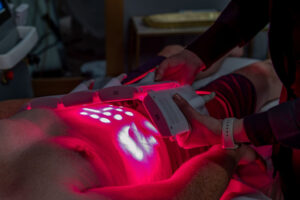
Depending on the Fotona treatment and settings, laser energy can be delivered to the surface or deeper layers to create controlled thermal effects and stimulate collagen remodeling. Certain Fotona modes are non-ablative, meaning they can treat the skin without removing the epidermis. (Fotona)
For someone who doesn’t want needles or wants a treatment that can be customized around their desired downtime, Fotona may offer an appealing alternative to traditional microneedling.
That doesn’t necessarily mean one treatment is better for everyone. The right option depends on your skin, concerns, goals, and the results you’re hoping to achieve.
Fotona vs. CO₂ Laser Treatments
CO₂ laser resurfacing is another popular aesthetic treatment, particularly for more significant skin resurfacing, wrinkles, sun damage, and scars.
The important distinction is that traditional CO₂ resurfacing is an ablative treatment. It intentionally removes layers of skin to stimulate new skin formation and collagen production. Because the skin has been resurfaced, the healing process can involve significant redness, swelling, and downtime. Cleveland Clinic notes that recovery following CO₂ laser resurfacing can take up to two weeks, depending on the treatment. (Cleveland Clinic)
Fotona can offer a different approach.
Because Fotona’s settings and treatment modes can be customized, your provider can choose a treatment intensity appropriate for your goals and desired recovery time. Some Fotona modes are non-ablative and designed to stimulate collagen without removing the skin’s surface. (Fotona)
This means patients don’t necessarily have to choose between doing nothing and undergoing an aggressive resurfacing procedure.
At Balanced Body, we can customize your Fotona treatment plan based on the results you’re looking for, your comfort level, and how much downtime you’re willing to have.
What Does “Non-Invasive” Really Mean?
The term “non-invasive” is used frequently in the aesthetic industry, but it can be confusing.
Generally, a non-invasive treatment does not require an incision, surgical entry into the body, or needles penetrating the skin. Non-ablative laser treatments work by delivering energy into the targeted tissue without removing the skin’s surface.
This is different from an ablative procedure, which intentionally removes layers of skin.
Fotona offers both superficial and deeper treatment capabilities, and the specific level of treatment depends on the modality and settings selected. This is important because not every laser treatment should be described as completely “no downtime.” Recovery varies depending on the specific treatment performed.
At Balanced Body, our goal is to select the Fotona treatment approach that makes sense for your individual needs rather than automatically using the most aggressive setting available.
Less Downtime Without Giving Up Results
One of the biggest reasons patients are interested in Fotona is the balance between results and recovery.
More aggressive resurfacing treatments can produce dramatic changes, but they can also require significant downtime. Other treatments may have little downtime but may not address the concerns you’re trying to improve.
Fotona gives providers a range of treatment options. Certain Fotona treatments are designed to provide rejuvenation with minimal downtime and discomfort, while other settings can be used when a more intensive treatment is appropriate. (Fotona)
That flexibility makes Fotona particularly appealing for patients who want to improve their skin while still maintaining their normal schedule.
A Personalized Approach to Laser Treatments in St. Louis
Your age, skin condition, goals, previous treatments, tolerance for discomfort, and desired recovery time can all influence which treatment, and approach makes the most sense for you.
During your consultation, we’ll discuss what you’d like to improve and help determine an appropriate treatment approach. Whether your priority is smoother-looking skin, improved firmness, fewer visible lines, better overall skin appearance, or targeted treatment around the eyes, lips, face, or neck, your plan can be customized accordingly.
For patients in St. Louis, Crestwood, South St. Louis, and surrounding communities, Fotona offers an exciting option for non-surgical facial rejuvenation without automatically committing to the downtime associated with more aggressive laser resurfacing.
Is Fotona Right for You?
If you’ve been considering microneedling, CO₂ laser resurfacing, or other aesthetic treatments but aren’t sure which option is right for you, Fotona may be worth exploring.
Its combination of Er:YAG and Nd:YAG laser technology, customizable treatment settings, and ability to address different tissue depths gives providers a versatile platform for skin rejuvenation and aesthetic treatments. (Fotona)
Most importantly, the goal isn’t simply to choose the newest technology. It’s to choose the treatment approach that fits your goals.
At Balanced Body Weight Loss & Wellness, our Fotona laser treatments are designed around you—from the results you want to achieve to the amount of downtime you’re comfortable with.
If you’re ready to learn whether Fotona is a good fit for your skin goals, schedule a consultation at Balanced Body in St. Louis, MO and discover what personalized laser treatment can do for you.